So you've got a big idea. You want to build the next Zomato, the next Swiggy, or maybe something even better. You've watched these platforms go from scrappy startups to billion-dollar empires, and now you are wondering how they did it, and more importantly, how you can do it too.
The truth is, building a food delivery app is not just a coding project. It is a full-scale digital product that touches mobile app development, real-time tech, logistics, payment gateways, AI recommendations, and marketing, all working together as one integrated experience. If done right, it is one of the most profitable digital ventures out there right now.
Step 1: Understand the Business Model
Before a single line of code is written, you need to understand what kind of food delivery platform you are building. There are three core models used by the giants:
- Aggregator Model: You list restaurants and handle discovery and ordering. The restaurant handles delivery (like early Zomato).
- Logistics and Aggregator Model: You handle both ordering and delivery using your own fleet. This is how Swiggy and Uber Eats largely operate today.
- Cloud Kitchen Model: You operate your own kitchens and deliver food directly, without relying on third-party restaurants.
Most successful apps today use the second model: the full-stack logistics plus aggregator approach. This requires more investment but gives you full control of the customer experience and determines how complex your tech stack needs to be.
Step 2: Map Out the Core Features
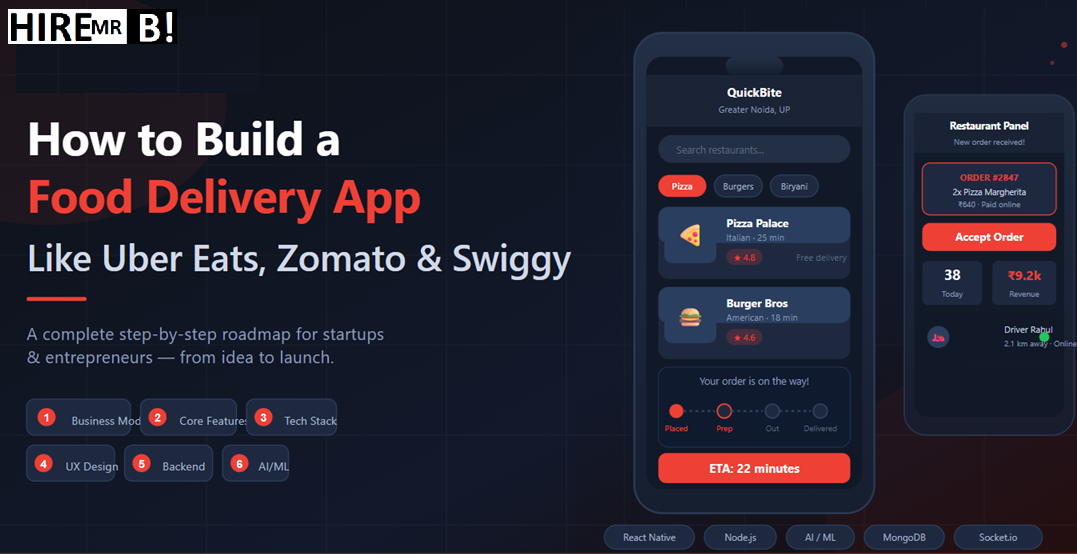
Every great food delivery app is made up of three separate apps talking to each other in real time. The Customer App handles user registration, smart restaurant search, real-time order tracking, multiple payment options, ratings, loyalty rewards, and AI-powered food recommendations. The Restaurant/Vendor App lets restaurants receive and manage orders, update menus, view analytics, and communicate delays. The Delivery Partner App lets agents accept requests, navigate via GPS, track earnings, and communicate with customers.
Step 3: Choose the Right Tech Stack
Here is what the best engineering teams use for food delivery platforms:
- Frontend: React Native or Flutter for cross-platform mobile apps; React.js for admin dashboards
- Backend: Node.js for real-time event-driven logic; Express.js or NestJS for API architecture; Python for data-heavy ML pipelines
- Database: PostgreSQL for structured data; MongoDB for flexible schema-less data; Redis for caching and real-time queues
- Real-Time: Socket.io or Firebase Realtime Database for live order tracking
- Cloud: AWS, Google Cloud, or Azure with Docker and Kubernetes for scalable containerised deployment
- AI/ML: Python with scikit-learn and TensorFlow for recommendation engines and predictive ETAs
Step 4: Design the User Experience
People do not just order food; they experience your app. The design of platforms like Swiggy and Uber Eats is obsessively tested and refined. Key UX principles: speed above everything (users abandon apps that take more than 3 seconds to load), one-tap ordering (fewer clicks = better conversion), visual hierarchy for menus with high-quality food photography, real-time feedback with live tracking and ETAs, and intuitive navigation so first-time users can order without any instructions.
Step 5: Build the Backend Infrastructure
Your backend is the heart of the application. Key components include an Order Management System (OMS) that tracks the complete lifecycle of every order, geolocation and route optimisation via Google Maps API or Mapbox, push notifications via Firebase Cloud Messaging, payment gateway integration (Razorpay, Stripe, or PayU), surge pricing logic for peak hours, and a powerful admin dashboard for order monitoring, dispute management, and real-time analytics.
Step 6: Integrate AI and Machine Learning
This is where big players have separated themselves from smaller competitors. AI capabilities that matter most in food delivery:
- Personalised Recommendations: show users restaurants and dishes based on history, time of day, and location
- Predictive Delivery Time: ML models that analyse traffic, prep times, and driver availability for accurate ETAs
- Dynamic Delivery Zone Optimisation: AI that adjusts coverage zones based on demand patterns
- Fraud Detection: catch fake orders and suspicious payment activity before they damage your platform
- Chatbot Customer Support: AI-powered chat for common queries without needing a human agent
Step 7: Testing, QA & Launch
Before going live, your app needs rigorous testing: functional testing across all user types, performance testing (can your backend handle 1,000 simultaneous orders?), device compatibility across Android and iOS screen sizes, extensive payment gateway testing (success, failure, refund, partial capture), and security testing for user data and payment flows. A phased rollout, starting with a single city, is the smartest launch approach.
Step 8: Post-Launch: Grow and Scale
Launching the app is actually the beginning, not the end. Growth levers include targeted digital marketing campaigns (Google, Instagram, Facebook), referral programs for low-cost high-return acquisition, aggressive restaurant partner onboarding in your target area, loyalty programs (points, streaks, subscription models like Swiggy One), and data-driven decision making from your app's analytics. Scaling also means investing in infrastructure upgrades, developer capacity, and potentially international expansion.
The Cost of Building a Food Delivery App
A basic MVP food delivery app with core features for a single city typically costs between $15,000 to $40,000, depending on geography, feature set, and team structure. A full-featured platform with AI recommendations, multiple cities, a dedicated admin panel, and advanced analytics can range from $60,000 to $150,000+. When you hire dedicated full stack developers through a reliable partner like HireMisterB Digital, you get significantly better value than hiring in-house or going through expensive Western agencies.
Why Partner With HireMisterB Digital
We are not just another IT company. We are a team of engineers, designers, marketers, and digital strategists who have built products across food tech, healthcare, fintech, edtech, and more. Whether you are a startup building your first MVP or an established business ready to scale digitally, we have the expertise and the team to make it happen. The food delivery market is still wide open. Secondary and tertiary cities remain underserved, niche verticals are growing fast, and markets in Southeast Asia, the Middle East, and Africa are expanding rapidly. Your idea might just be the next big thing in food tech.
Share Article
About the Author

Bipin Verma
LinkedInManaging Director
HireMisterB Digital
Bipin Verma is the Managing Director of HireMisterB Digital Private Limited. A strategic tech consultant with 12+ years of experience, he has led digital transformation engagements across food tech, healthcare, fintech, and enterprise platforms for clients spanning India, the USA, and EMEA.