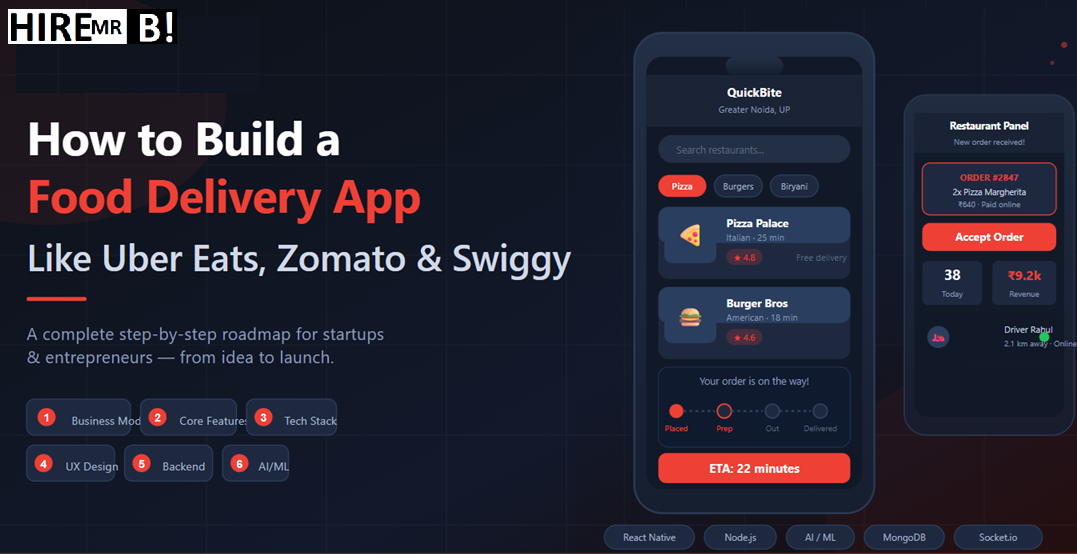
As a Tech Consultant with expertise spanning Web, Apps, AI, and Blockchain, one of the most critical conversations I have with founders and enterprise leaders is about the Minimum Viable Product (MVP). Many see an MVP as just a "lite" version of their idea. In reality, it is a strategic powerhouse that can save you millions and shave years off your development cycle.
Defining the MVP: More Than Just "Basic"
The term "Minimum Viable Product" was popularised by Eric Ries in The Lean Startup. To truly understand it, we must look at the three words individually. Minimum means the smallest set of features required to function. Viable means it must actually solve the user's problem. A car without a steering wheel is "minimum" but it is not "viable." Product means it is a tangible, usable tool, not just a sketch or wireframe.
MVP vs. Prototype vs. PoC
These terms are often used interchangeably in consulting conversations, but they are distinct stages in the development lifecycle:
- Proof of Concept (PoC): Purely technical. Can we actually build this AI algorithm? Does this Blockchain integration work? It proves feasibility, nothing more.
- Prototype: Focuses on UX/UI. It is a clickable model (often in Figma) to show investors or stakeholders how the app feels. It has no backend.
- MVP: The first version that hits the market. It has a real backend, processes real data, and provides real value to early adopters.
Core Benefits of Starting with an MVP
Drastic Risk Mitigation
Building a full-scale Salesforce integration or a complex IoT dashboard takes time. If you build the wrong features, you lose that capital. An MVP allows you to "fail fast" and "fail cheap." If the market rejects the core premise, you pivot before you have spent your entire budget.
Faster Time-to-Market (TTM)
In tech, speed is a competitive advantage. An MVP allows you to launch in weeks rather than months. This lets you stake your claim in the market and start building your user base while your competitors are still in the design phase.
Feedback-Driven Development
Real users will use your product in ways you never imagined. By launching an MVP, you gain access to "validated learning." This data tells you exactly which features to build next, ensuring that every dollar spent on Phase 2 is backed by user demand, not assumptions.
How to Build a Successful MVP: A Step-by-Step Framework
- Step 1: Identify the Core Problem: Start with the pain, not the features. What is the #1 headache for your users? Focus on solving that one thing exceptionally well.
- Step 2: Define Your Target Audience: You are building for early adopters who feel the pain so acutely they are willing to use a minimum product if it solves their problem.
- Step 3: Feature Prioritisation Matrix: Categorise features as Must-Have (core engine), Should-Have (important but can wait), Could-Have (nice to have), and Won't-Have for now. Your MVP is only the Must-Haves.
- Step 4: Choose the Right Tech Stack: Choose technologies that allow for rapid iteration: React/Node.js for web, Flutter for cross-platform apps, Python/TensorFlow for AI. Flexibility and scalability are the goal.
- Step 5: Build, Measure, and Learn: Track Activation Rate (do users complete the core action?), Retention (do they come back?), and Feedback Loops (what are they complaining about?). Use this data to drive every subsequent build decision.
Common Pitfalls to Avoid
- The "Minimum Awful Product": Do not sacrifice quality for speed. If the app crashes or the UI is unusable, you are not testing the idea; you are testing a bad implementation.
- Feature Creep: The temptation to add "just one more thing" before launch is the death of many MVPs. Stay disciplined. Ship the Must-Haves.
- Ignoring Data: If data shows users are not using a feature you love, be willing to kill it. Attachment to your own assumptions is the enemy of product-market fit.
Real-World Success Stories
Airbnb's MVP was a simple website offering air mattresses in the founders' apartment during a local conference. No fancy search, no maps: just a listing and a payment button. Dropbox's "MVP" was not even a product: it was a 3-minute video demonstrating how the file-syncing would work. The waitlist jumped from 5,000 to 75,000 overnight, validating demand before a single line of the final sync code was written. Both examples prove the same truth: the goal of an MVP is not to build a product; it is to validate a hypothesis.
Final Thoughts
In my years as a Tech Consultant, I have seen that the most successful products are not the ones that launched with the most features; they are the ones that learned the fastest. Whether you are looking to integrate AI into your workflow, launch a Blockchain solution, or build a custom Salesforce CRM extension, the MVP approach is your roadmap to success. It is about building a foundation that is strong enough to support your vision but flexible enough to evolve with your users.
Looking to build your next big idea? At HireMisterB Digital, we help businesses turn concepts into market-validated products with expert consulting, full-stack development, and post-launch growth support. Let's connect.
Share Article
About the Author

Sachin Verma
LinkedInEMEA Head, Growth and Business Development
HireMisterB Digital
Sachin Verma heads business development and growth across EMEA markets at HireMisterB Digital. A technology consultant at heart, he has guided early-stage startups and enterprise product teams through MVP strategy, platform selection, and go-to-market execution across the UK, UAE, and India.